Proforma before you bill
Generate a print-ready proforma estimate straight from a job's costing — save it as a PDF in a tap — so the client sees the number before the work, not a surprise after.
Invoicing
A practice's own invoices get scrutinised harder than anyone's — your clients are auditors. T4Suite raises a GST-ready proforma from a job's costing before you bill, then turns it into a tax invoice with the tax split, HSN/SAC summary and amount-in-words done correctly, every time.
And when the billing entity isn't GST-registered, it issues a compliant Bill of Supply instead — no manual switching, no wrong document.
Part of T4Suite's CA practice management software and its office management software.
Generate a print-ready proforma estimate straight from a job's costing — save it as a PDF in a tap — so the client sees the number before the work, not a surprise after.
CGST + SGST for intra-state, IGST for inter-state — split automatically from the GSTIN's state — with a per-HSN/SAC tax-summary table and the amount written in Indian lakh/crore words.
Flag an entity as unregistered and T4Suite issues a Bill of Supply with no GST instead of a tax invoice — the right document for the entity raising it.
A junior prepares an invoice; it leaves the firm only when a partner approves it. Issued invoices are permanent records — reverse or correct one with a compliant credit note rather than deleting a raised bill.
A firm's audit LLP in West Bengal bills a company client for two pieces of completed work: the statutory audit at ₹25,000 and the company's income-tax return at ₹5,000. Each service carries its own SAC code from the firm's services list, so the invoice can summarise tax by code.
| Service | SAC | Taxable value |
|---|---|---|
| Statutory audit, FY 2025-26 | 998221 | ₹25,000 |
| Income-tax return, AY 2026-27 | 998231 | ₹5,000 |
| CGST at 9% | ₹2,700 | |
| SGST at 9% | ₹2,700 | |
| Total | Rupees Thirty-Five Thousand Four Hundred only | ₹35,400 |
If the same client were registered in Jharkhand, the state code in its GSTIN would differ from the firm's, and the invoice would carry IGST of ₹5,400 instead of the CGST and SGST lines. The total is the same; who receives the tax is not. T4Suite reads the two state codes and chooses; nobody picks it from a menu.
Under the lines, a summary shows each SAC code with its taxable value and tax, and the amount is written in Indian words, in lakh and crore.
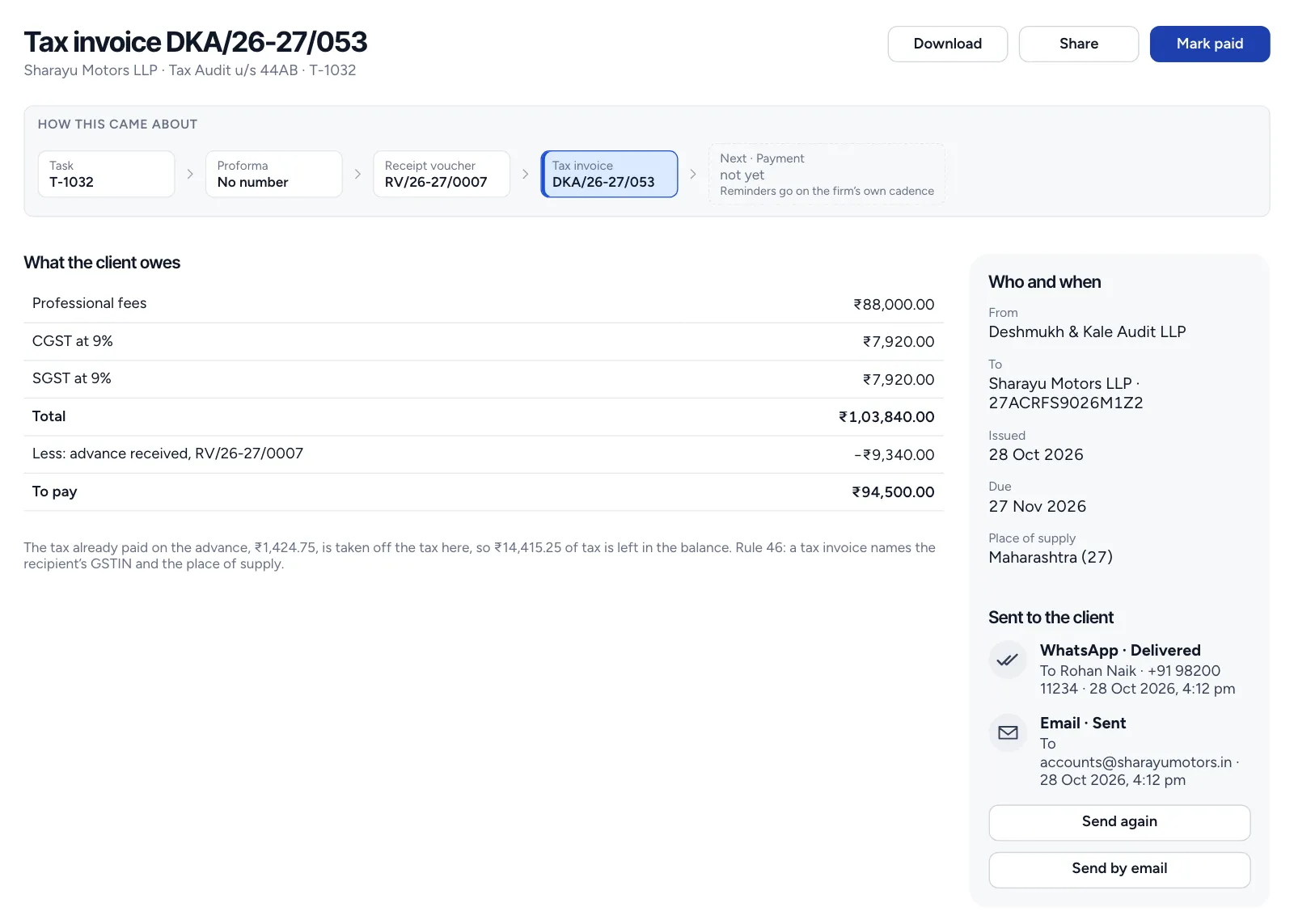
Rule 46 of the CGST Rules asks for invoice numbers that run in order, are unique in the financial year, and are no longer than 16 characters. In T4Suite each entity has its own series. An invoice from the sample firm's audit LLP is numbered like DKA/26-27/0042: the entity's prefix, the financial year and the serial, 15 characters in all. The serial starts again on 1 April.
A firm with an audit LLP and a separate tax practice therefore keeps two clean series, one per GSTIN, without anyone keeping a register on the side. The number is given only when the invoice is issued, so a draft that is thrown away never leaves a gap.
An entity cannot issue an invoice until its details are complete: bank details always, so the client knows where to pay, and a GSTIN when the entity is registered. The message says exactly which of the two is missing, not a general complaint.
A partner can issue an invoice directly. When anyone else raises one, it goes to a partner for approval first, and it gets its number only when it is approved. Until then a draft can be deleted. Once issued, an invoice is an accounting record: it is never deleted, and a mistake is put right with a credit note.
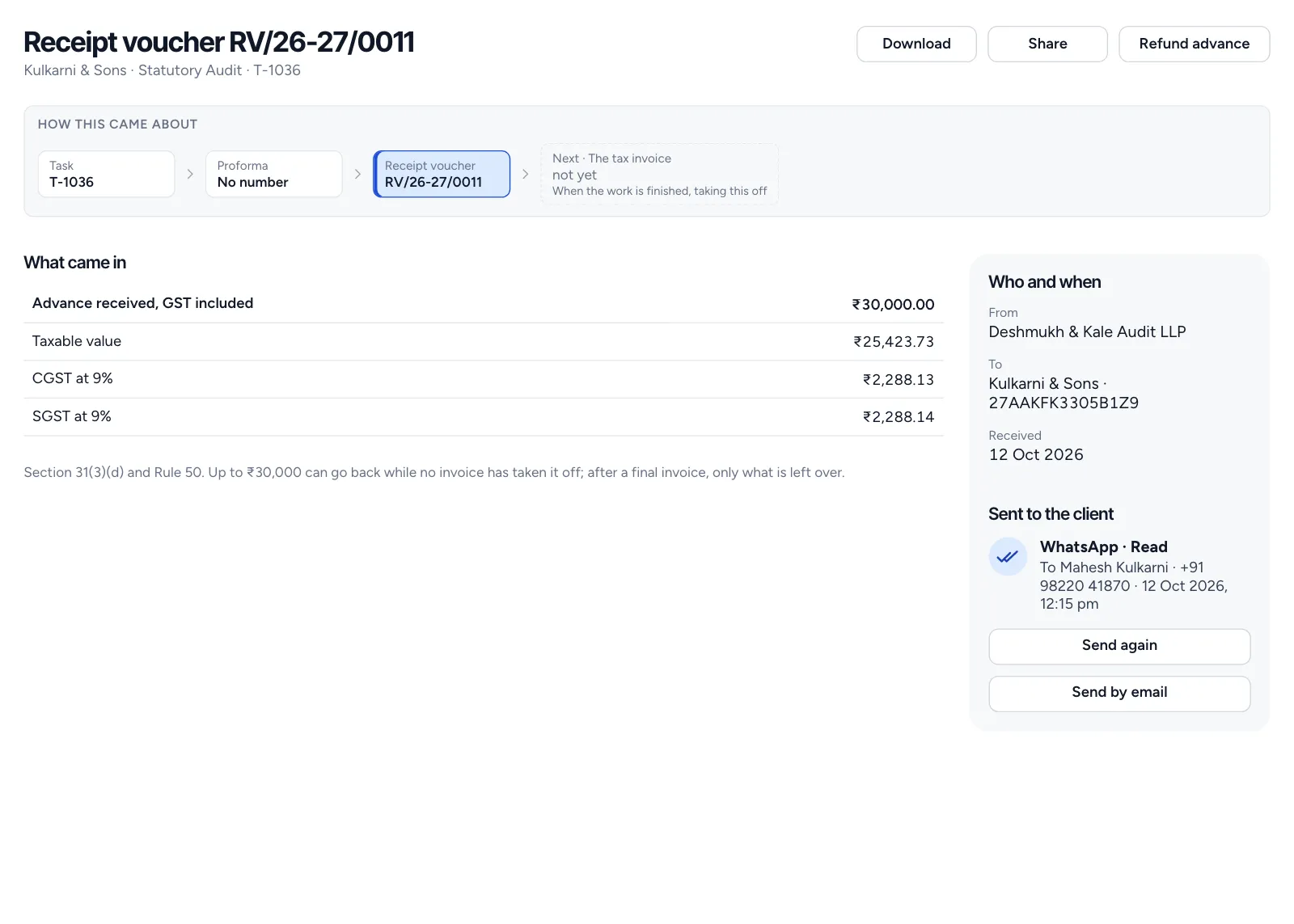
When a firm asks for money before starting, T4Suite sends a proforma. A proforma has no invoice number, because it is not a tax invoice, and no GST falls due on money that may never come.
When the advance arrives, it is recorded on a receipt voucher, and the tax is worked out inside the amount received. On an advance of ₹11,800 at 18%, the voucher shows ₹10,000 of value and ₹1,800 of tax (₹11,800 × 18 ÷ 118). The final invoice then sets the advance against the full fee, so the client is never asked for the same money twice.
Yes. It reads the GSTIN's state code and applies CGST + SGST for intra-state supply or IGST for inter-state, with a per-HSN/SAC tax-summary table on the invoice.
Yes. If the billing entity is flagged as not GST-registered, T4Suite issues a Bill of Supply (no GST) instead of a tax invoice, automatically.
From the completed job's costing — the proforma and the final invoice both build from the same figures, so the estimate and the bill never disagree.
Each entity has its own series, such as DKA/26-27/0042: the entity's prefix, the financial year and a serial that restarts on 1 April. It stays within Rule 46's 16 characters, and a number is given only when an invoice is issued.
A junior can raise one, but it goes to a partner for approval and gets its number only when approved. A partner can issue directly.
A short walkthrough, mapped to your firm's entities and services.