Bills flow from completed work
A bill is raised from a job once it's completed, and the amount comes from that job's fee — so every invoice traces back to real work, never a blank line-item screen.
Billing & receivables
Most firms do the work in one place and the billing in another, and the gap between them is where receivables go to die. T4Suite raises the bill from the job itself — when a job is completed, its fee becomes the invoice — so what you did and what you charged never drift apart.
Drafts, issued invoices and what's still owed sit on the same client record — per legal entity — so chasing money is a list, not a memory test.
Part of T4Suite's CA practice management software and its office management software.
A bill is raised from a job once it's completed, and the amount comes from that job's fee — so every invoice traces back to real work, never a blank line-item screen.
Services defined once in your master — grouped by GST, income tax and audit, each with its SAC code — price the work on every task, so a GST retainer or an audit fee is consistent across clients.
Every issued invoice that is not yet paid counts as owed, and one past its due date is marked past due, so partners see who owes what without opening a spreadsheet.
Billing is scoped to the active legal entity, so your audit LLP and your tax advisory keep their invoices apart — and a wrong invoice is corrected with a credit note, never silently deleted.
Take a private company that the firm's audit LLP serves all year: its monthly GST returns at ₹5,000 a month and its tax audit at ₹40,000, with 18% GST on each. On 10 December 2026, the client's page shows these bills.
| Bill | Where it stands | Still to pay |
|---|---|---|
| DKA/26-27/0031 · GST returns, October · ₹5,900 | Paid on 3 November | — |
| DKA/26-27/0044 · GST returns, November · ₹5,900 | Issued 21 November, due 30 November: past due | ₹5,900 |
| DKA/26-27/0052 · Tax audit · ₹47,200, less ₹11,800 advance received | Issued 1 December, due 15 December | ₹35,400 |
| Draft · GST returns, December | Waiting for a partner's approval | not yet owed |
| Owes | ₹5,900 + ₹35,400 | ₹41,300 |
Only issued invoices count. A draft, or one waiting for approval, is work the firm has not yet billed, so it is not money the client owes. A paid invoice drops out. An advance already received is taken off the invoice it belongs to, so the client is never chased for money they have already paid.
The November bill is past due because its due date has gone and it has not been marked paid. The same mark shows on the client's page, on the firm's billing list, and on the invoice itself.
The bill follows the task. When the work is completed, someone with the billing right raises the bill. If that person is a partner, the invoice is issued at once and takes the next number in the entity's series. If anyone else raises it, it waits for a partner's approval and gets its number only then.
Until it is issued, a bill can be taken back: the task goes back to completed and the draft is removed. After it is issued, it is an accounting record. T4Suite never deletes it, and even cancelling the task leaves the issued invoice in place.
When the money comes in, the task is marked paid, and so is its bill. Only an issued bill can be marked paid, so nothing is settled that was never invoiced.
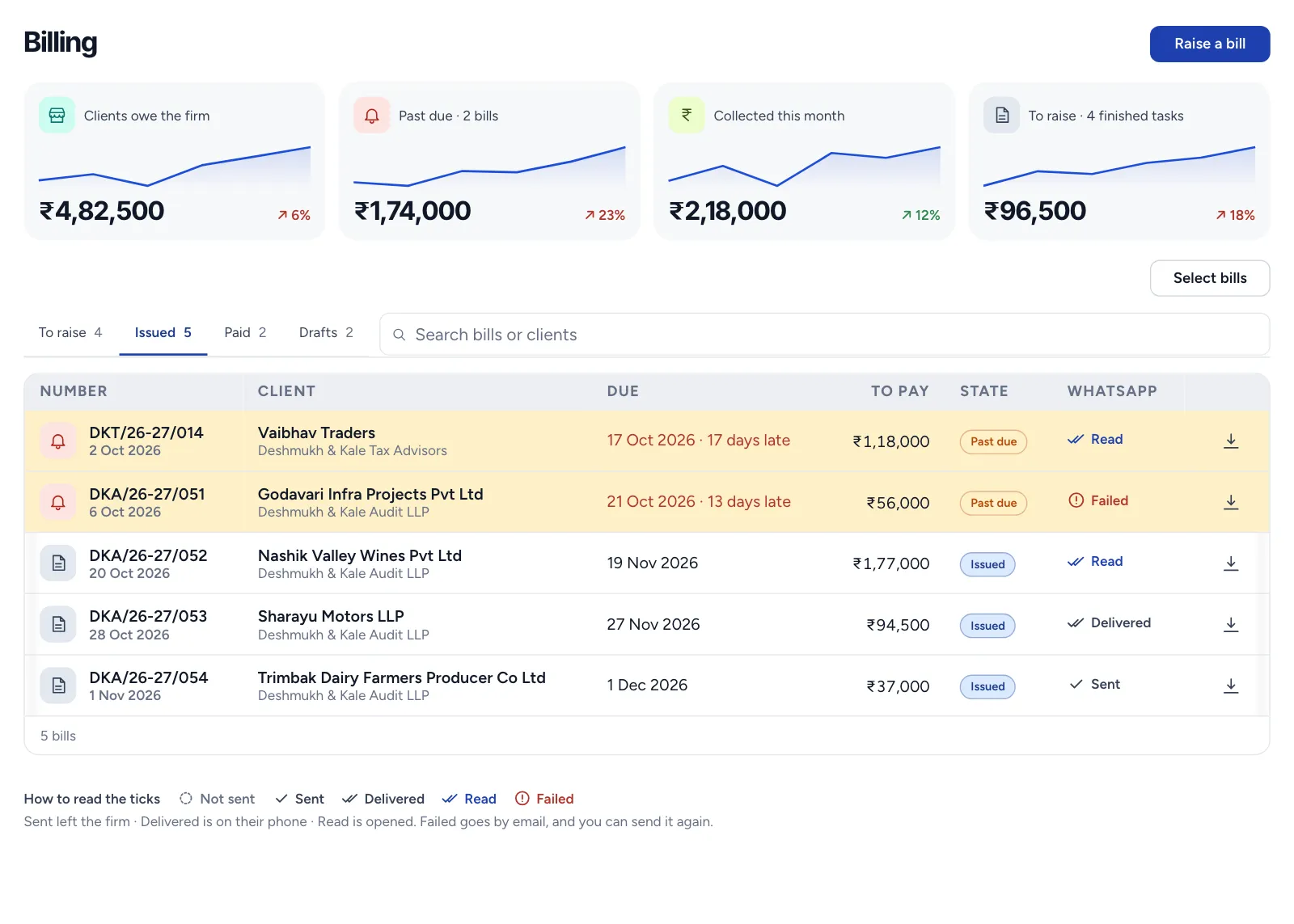
The billing page gives three figures for the entity you are working in: what clients owe in all, what was invoiced this month, and what came in this month. Below them are the bills, waiting ones first, then issued and paid ones, each with its client, number, amount and due date.
The list can be narrowed to one entity or to one client. A firm that runs an audit LLP and a separate tax practice sees each one's receivables apart, because each issues its own invoices under its own GSTIN. A partner who works across both can see the whole firm.
Seeing bills is a right of its own. A role without it, such as the article assistant's in the starting roles, does not see the billing page or what a client owes.
We would rather say this here than in a demo. A bill is marked paid when it is settled in full; part payments are not recorded against it. And there is no ageing table in 30, 60 and 90-day bands; the list shows each bill's due date and whether it is past due.
T4Suite is not the firm's accounting software either. It issues the invoices and tracks what is owed; the firm's books stay where they are.
From a task once it is completed. The task's fee becomes the invoice lines, so the invoice traces directly to the work done.
A partner issues directly. When anyone else with the billing right raises a bill, it waits for a partner's approval and takes its number only when it is approved.
Every issued invoice not yet marked paid, less any advance already received against it. Drafts and bills waiting for approval do not count.
No. Once issued it is an accounting record. A wrong invoice is corrected with a credit note, never deleted.
Not yet. A bill is marked paid when it is settled in full.
Yes. Each entity issues its own invoices under its own GSTIN and number series, and the billing list can be narrowed to one entity or one client.
A short walkthrough, mapped to your firm's entities and services.