CA practice management software
CA practice management software, from the engagement to the paid bill
A CA firm sells hours against deadlines. Each return, audit and filing has a client, a due date set by law, people who do the work, and a fee. Practice management software holds all four in one record, so a partner can answer three questions without asking anyone: what is due, what did it cost, and what has not been billed yet.
T4Suite is practice management software built for Indian CA, CS and compliance firms. This page walks through what it does with one engagement, from setting it up to the paid bill, with real rules the software applies and a costing worked out in rupees.
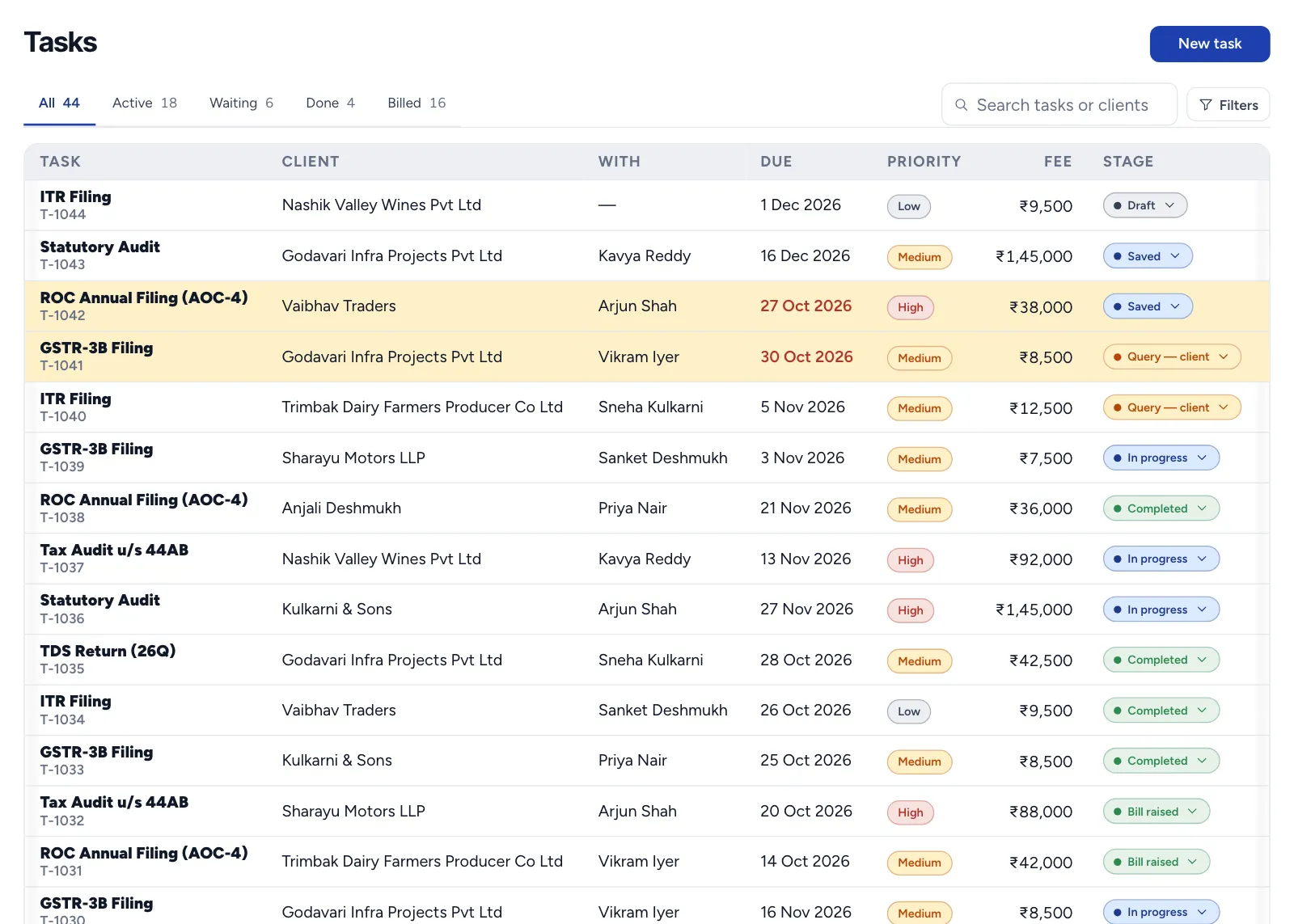
Every engagement has an owner, a deadline and a stage
In T4Suite an engagement is a task. The partner or manager sets it up once: the client, the service, the people, the dates and the fee. Give it to one person and it is a task; add a second person and it becomes a project, with each person's hours counted on their own line.
Every task moves through the same stages: open, in progress, waiting on a query, completed, billed and paid, with an advance stage for firms that ask for money up front. The stage is not a label someone types. Each move has a rule behind it:
- Only the people assigned can log time
- A timer runs only for someone on the task, and only while it is in progress. When the task leaves that stage the timer stops by itself, and a timer left running is closed at 12 hours.
- A query holds the task
- When a document is missing the associate raises a query, and the task shows as waiting. It cannot be marked completed until it goes back to in progress.
- Completion has a date that is not in the future
- Marking work completed records the date. A future date is refused, and choosing the date needs manager or approver rights.
- Setting the fee is its own right
- Creating work needs the right to assign it. Setting the fee and the costing needs a separate right, so a senior associate can plan work without seeing the money.
Read more: Follow one engagement through every stage
Deadlines that set themselves up
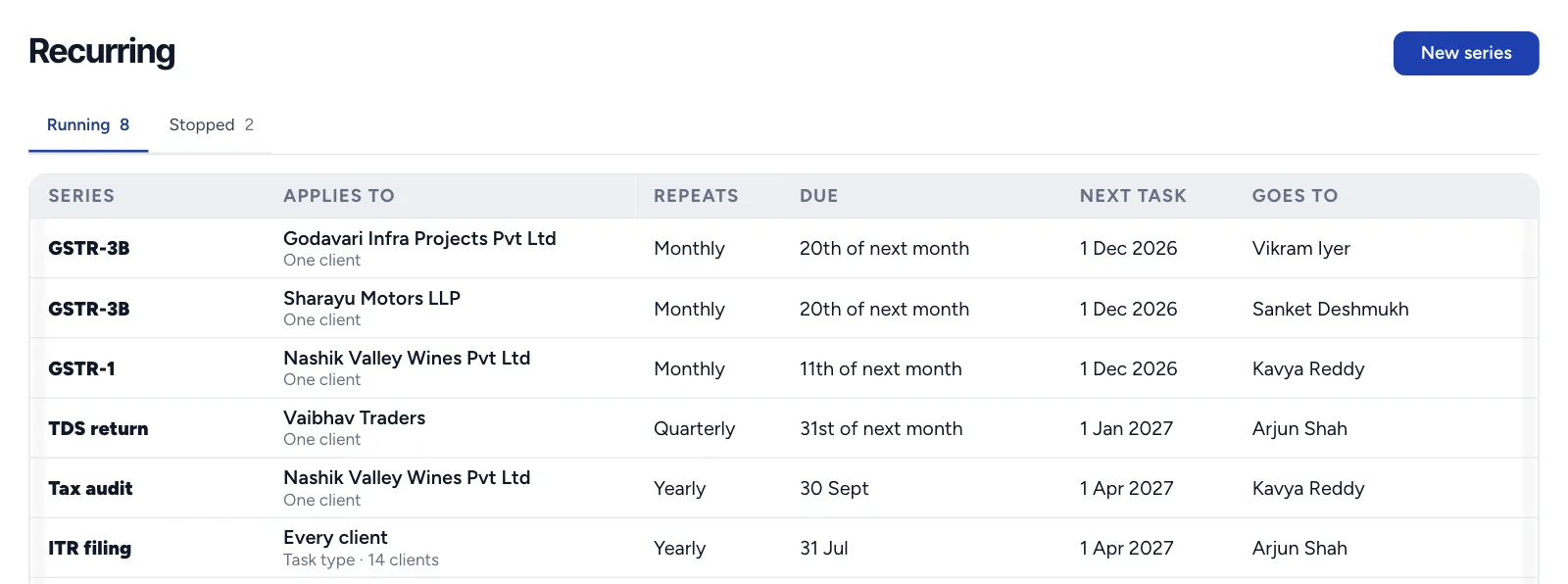
Most of a practice repeats. A monthly GST return for one client is twelve tasks a year; for eighty clients it is nearly a thousand. Typing each one is where a deadline gets missed.
In T4Suite a return that repeats is a series. You set it once with its frequency (monthly, quarterly or annual) and its due rule, and each period's task appears by itself on the compliance calendar on its real date. Quarterly and annual series follow the Indian financial year. GST, TDS and TCS returns, and audit work, sit on the same calendar, and each instance is costed and billed like any other task.
Nobody has to remember to look. Whoever is assigned gets a first nudge when the task is due within a week, and a final one the day before, on the day, or just after it is overdue. Each nudge appears in the app and on the phone, and it is sent once. If the reminder run is missed, it catches up on the next run.
Read more: The compliance calendar · GST practice management
What an engagement really costs: a worked example
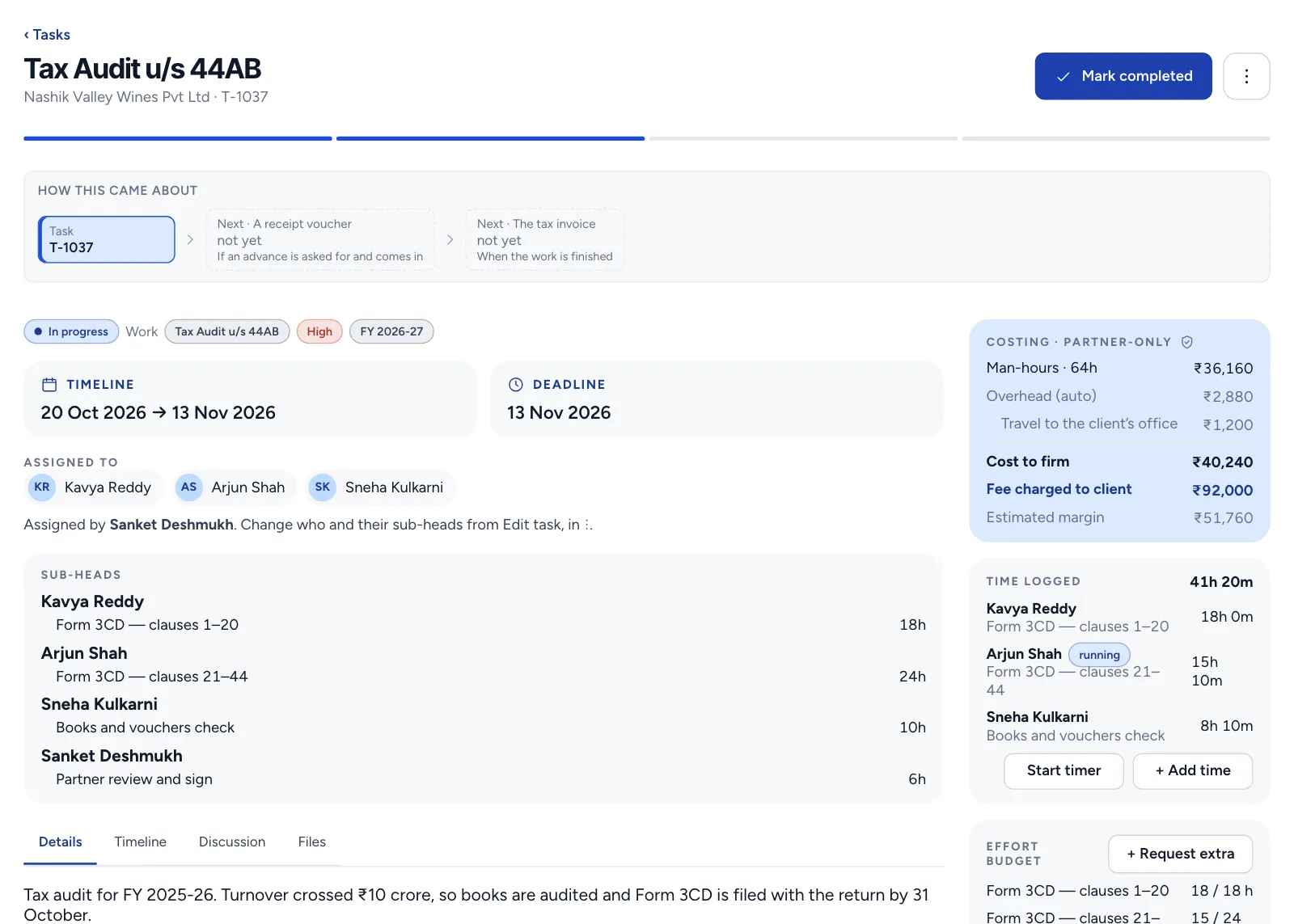
Most firms price on habit and learn the margin at year end. T4Suite works out the cost of each engagement from three things: the hours each person plans to spend, what an hour of that person costs, and a share of the firm's overheads.
An hour of a person's time starts at their yearly CTC divided by 2,000 hours, and the firm can change the rate on the task. Overhead is applied automatically. The year's overhead (rent, electricity, software and the rest) is divided by the hours the whole team works in a year, which is 2,400 a person unless the firm sets otherwise. Each job then carries its share for the hours it takes.
Take a five-person firm with ₹6,00,000 of overhead a year. Its team works 5 × 2,400 = 12,000 hours, so every hour of work carries ₹50 of overhead. It takes on a GSTR-9 annual return for a trading client at a fee of ₹8,000:
| Line | Working | Amount |
|---|---|---|
| Associate, CTC ₹4,80,000 | 10 hours × ₹240 | ₹2,400 |
| Manager, CTC ₹9,00,000 | 3 hours × ₹450 | ₹1,350 |
| Partner, CTC ₹16,00,000 | 1 hour × ₹800 | ₹800 |
| Overhead | 14 hours × ₹50 | ₹700 |
| Cost to the firm | ₹5,250 | |
| Fee | ₹8,000 | |
| Margin | ₹8,000 − ₹5,250 | ₹2,750 (34%) |
If the same return takes the associate 20 hours because the client's books are late, the cost rises to ₹8,150 and the job loses ₹150. Seeing that on the task, not in the year-end accounts, is the point. Fees the firm pays out for the client, such as a government fee, sit on both sides and do not count as margin.
The fee, the costing and the margin are hidden from anyone without the costing right. The team sees the work; the partners see the money.
Read more: Job costing and work in progress · Guide: how to price a CA engagement
The bill follows the work
In T4Suite a bill is raised from a completed task, never typed on its own. That one rule closes the commonest leak in a practice: work that was done and never billed. Completed tasks with no bill appear together on the dashboard, with their value in rupees, until someone bills them.
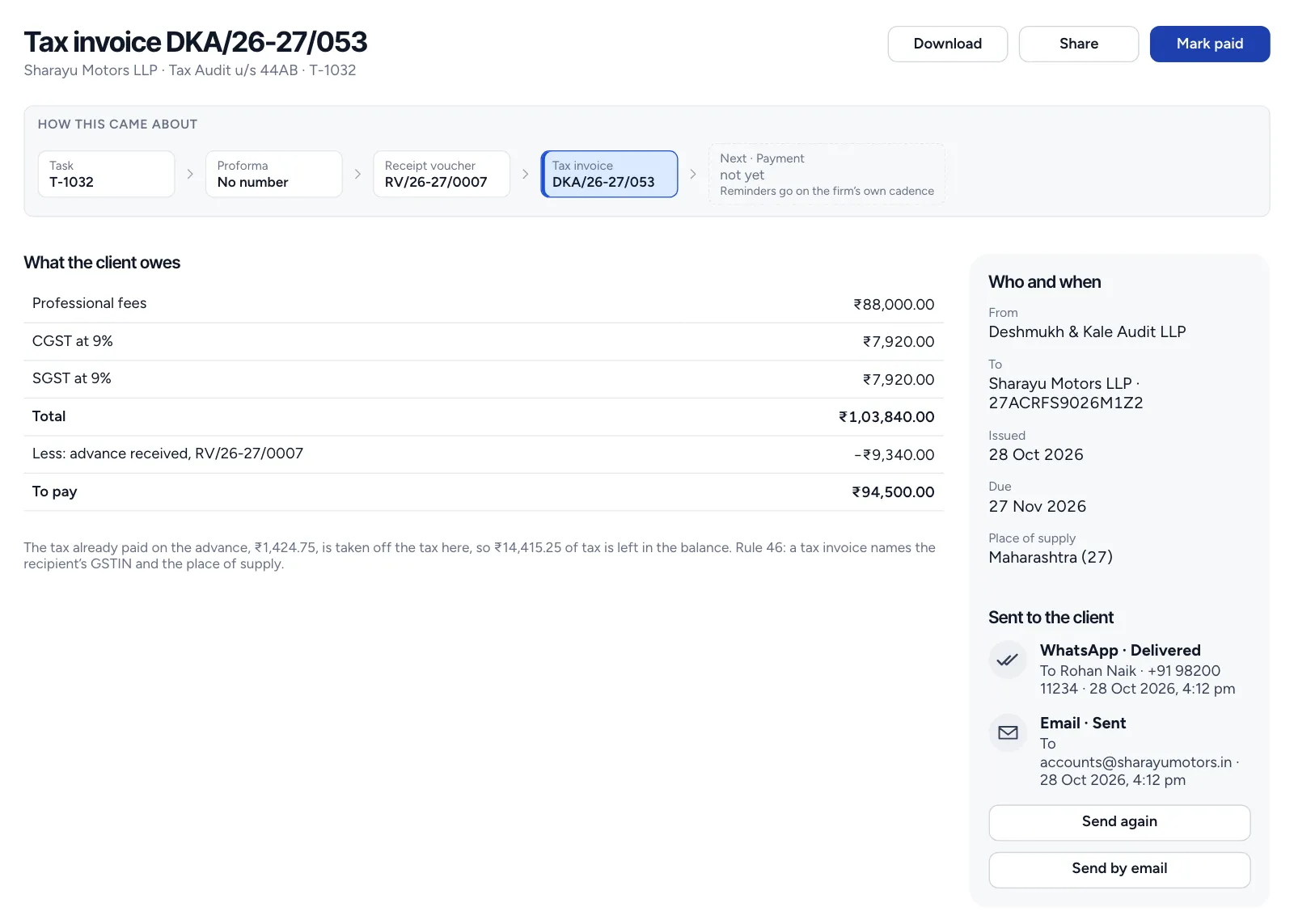
If the firm asks for money first, it sends a proforma with no invoice number. A proforma is not a tax invoice, so no GST falls due on money that may never arrive. When the advance comes in, it is recorded on a receipt voucher with the tax inside the amount received, and set against the final bill.
The final bill is numbered in the entity's own series. For a registered entity it is a GST tax invoice: CGST and SGST when the client is in the same state, IGST when the client is in another, decided from the GSTIN. For the return above, ₹8,000 becomes ₹9,440 with ₹720 CGST and ₹720 SGST; to a client in another state, ₹1,440 IGST. An entity that is not registered issues a Bill of Supply with no GST instead.
A task needs a client and a fee before it can be billed, and the entity's details must be complete first. Once a tax invoice is issued it cannot be un-raised, so the numbers in the series stay unbroken.
Read more: GST tax invoicing · Guide: GST invoice numbering rules
Getting paid, and knowing who has not
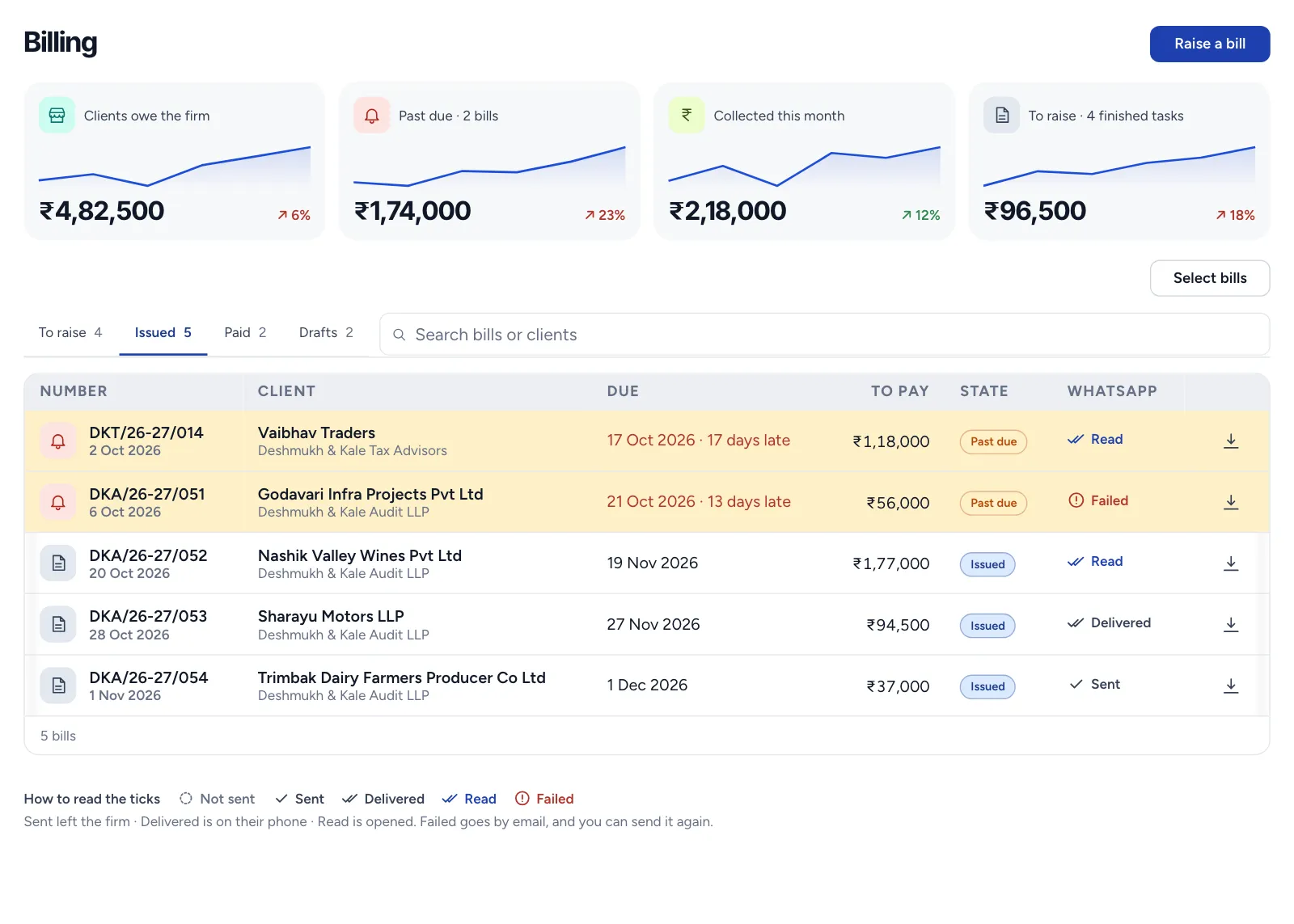
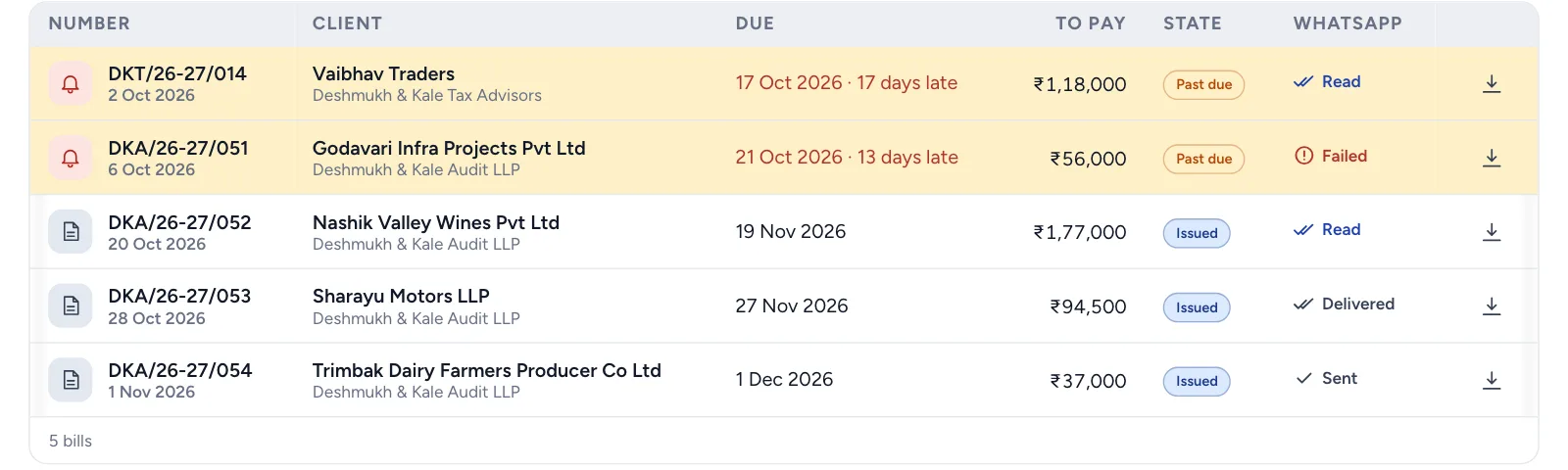
Billing shows, for each entity, what clients owe, what is past due, what came in, and what is still to be raised. A bill is marked paid only once its invoice is issued, so a payment can never be recorded against a draft.
Bills and updates can reach clients on WhatsApp, the channel most clients actually read. Messages come from Svasamm's WhatsApp number and name your firm, and they go only to clients who replied YES to a consent message. The billing register shows whether each bill was read.
Read more: Billing and receivables
Two entities, kept apart in one firm
Many firms run more than one legal entity: an audit LLP and a tax advisory firm, say, because the entity that audits a company should not also represent it on tax. T4Suite keeps them apart inside one firm. Each entity has its own clients, its own tasks and its own bill numbers, and partners switch between them without signing in again.
Six questions to ask any practice management software
Whichever product you choose, ask the seller to show you these on screen, with your own kind of work, not on slides:
- Can a bill exist without the work?
- If invoices can be typed freely, unbilled work stays invisible. Ask where the list of completed but unbilled work is.
- Does a repeating return create itself?
- Ask to see a monthly series set up once, and the next period's task appear on its own.
- Where does the cost of an hour come from?
- A flat rate for everyone hides which clients lose money. Ask whether the rate starts from each person's CTC.
- Who sees the fee?
- Ask to sign in as a junior associate and check that fees and margins are hidden.
- Is GST worked out, or typed?
- CGST, SGST or IGST should follow from the GSTIN, and an issued invoice should not be editable.
- Can it hold two entities apart?
- Separate bill series and separate client lists, without a second login.
Read more: T4Suite against spreadsheets · T4Suite against generic project tools
What it costs
T4Suite is priced per user a month, with no minimum: ₹99 on Starter, ₹149 on Growth and ₹199 on Scale, plus GST. Every paid plan has every feature described here; the plans differ in how many WhatsApp messages the firm gets. A five-person firm on Growth pays ₹745 a month, with 375 WhatsApp messages a month for the whole firm. Paying yearly gives two months free.
There is a free trial of 90 days for 2 users and 1 entity. It starts with a call, so we can set it up with your own kind of work.
Read more: Pricing in full
Practice management is the work. For the firm itself (the team, roles, attendance, notices, documents and phones), read T4Suite as office management software.
Screens show T4Suite's current design, with sample data. Worked figures are for a sample firm.
Questions firms ask
What is CA practice management software?
Software that holds a firm's engagements, their deadlines, the people on them, the time they take and the bills they lead to in one record. T4Suite adds costing from real hours and GST invoicing, so the record runs from the engagement to the paid bill.
Does T4Suite file GST or income tax returns?
No. It manages the work of filing: who is doing which return, by when, at what cost, and the bill for it. The filing itself is done on the government portals.
Can we bill without completing a task?
Not a final bill. A bill is raised from a completed task. For money up front, you send a proforma and record the advance on a receipt voucher, which is set against the final bill.
How is the cost of a job worked out?
Each person's hours times their hourly rate, which starts at their CTC divided by 2,000 hours, plus the firm's overhead for those hours and any direct costs. The fee less that cost is the margin.
Is there a free trial?
Yes, 90 days for 2 users and 1 entity, starting with a call. Book a demo and ask for it.
See it on your own firm's work
A short walkthrough, mapped to your firm's entities and services.